
 |
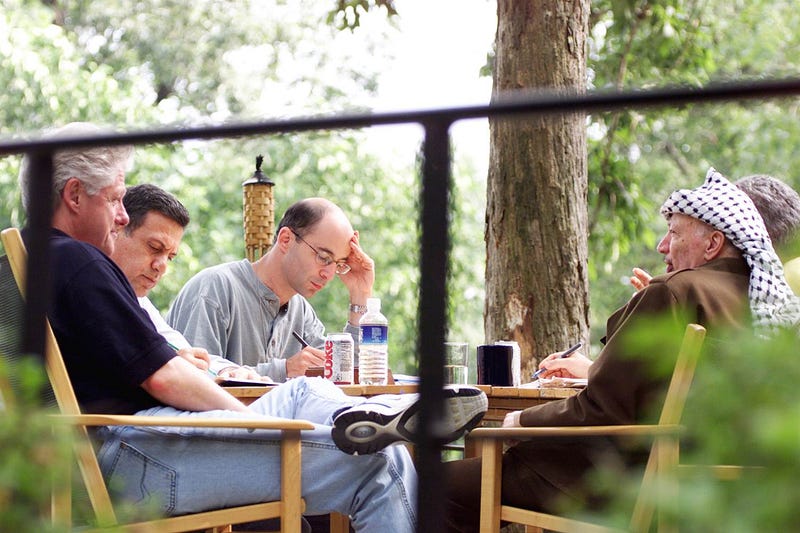
| President Clinton and Yasser Arafat, then-Chairman of the Palestine Liberation Organization (PLO) |
“If we’d had women at Camp David,” Bill Clinton later rued, “we’d have an agreement.”
There’s one thing that almost all negotiations between Israel and Palestine have had in common: a relative lack of women at the table.
It’s important not to neglect the important contributions several women have made to the much-maligned peace process. Dr. Hanan Ashrawi was a key player on the Palestinian team at the 1991 Madrid Conference as official spokesperson. Her prominence prompted the Israelis to summon their own female negotiator, Sarah Doron.
But by 1993, as talks towards the Oslo Accords progressed, it was clear that women would largely be limited to backseat roles.
One senior Palestinian negotiator at Oslo justified women’s exclusion by privately suggesting that the decisions taken were “too serious and monumental” for women to be involved as lead negotiators.
On the Israeli side, there was a clear divide: almost all the primary negotiators were men, while women were limited to the role of secretary, assistant or junior adviser.
Women’s lack of representation at the negotiating table has endured through the 20th and into the 21st century.
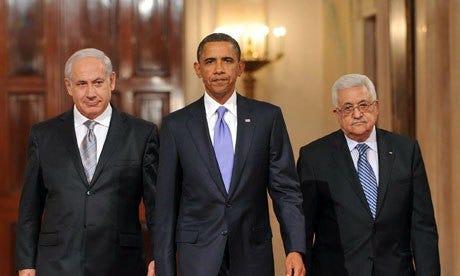 |
| L to R: Israeli PM Benjamin Netanyahu, US President Barack Obama, Palestinian President Mahmoud Abbas |
Perhaps “cultural” or social norms play a role.
In both societies and economies, patriarchal structures exist that discriminate against women. Women are less likely to work. Those women who do work are less likely to occupy senior roles and less likely to receive fair pay. Women are less likely to enjoy their fundamental human rights.
These social or cultural norms have ramifications for many walks of life in both Israel and Palestine. But discrimination against women in the military and political spheres in particular has resulted in fewer women being picked to lead or join negotiating teams.
There’s mandatory military conscription for women in Israel, but they’re much less likely than men to serve in combat positions. The perception endures that men are the “real” soldiers.
But cultural norms aren’t the only factor at play here. Politics is also to blame. (Side note: When isn’t it?)
In trying to understand women’s marginalization from peace negotiations between Israel and Palestine, Espanioli and Sachs found that the perpetuation of the conflict itself has pushed “gender” off the table.
The conflict and the occupation are all-consuming. Perhaps unsurprisingly, it defines political competition and discourse in Palestine and Israel alike. And while both parties remain at diplomatic and military loggerheads, these scholars argue that “gender” issues continue to be pushed aside.
Any discourse that detracts from the main objective for each party is seen as an unhelpful distraction, somehow of secondary importance: How can we talk about gender now when we should be focusing all our efforts on securing our borders?; How can we talk about gender now when we should be focusing all our efforts on ending the occupation?
I’m clear about the answer to the second question. Does it matter? Yes. But maybe not only for the obvious reasons.
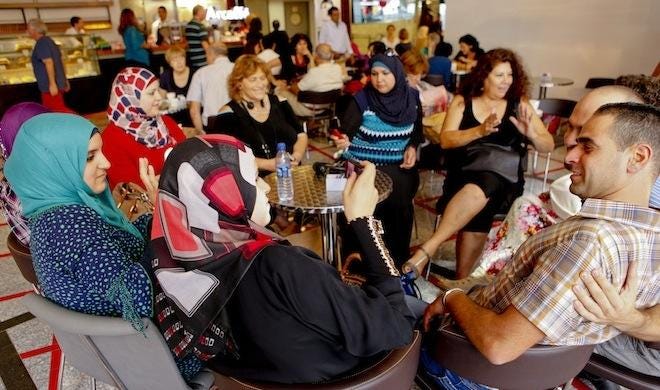 |
The same should go for government delegations sent to peace negotiations.
Some might make the same argument but in utilitarian terms. Countless studies have shown that businesses that effectively leverage diversity — including gender diversity — do better in a multitude of ways. They’re more profitable, they’re more fulfilling places to work, and they’re more likely to retain talented staff.
It’s been claimed that women are inherently more peaceful than men. This utilitarian argument would therefore predict that having more women sat at the negotiating table would increase the likelihood of success at the next stage of the peace process between Palestine and Israel.
I resist essentialist arguments: That any one group of people exhibits any particular strength or deficiency based on any given biological trait they bear: like the gender they identify with, or the color of their skin. And since there’s evidence for and against the idea that women are more inherently peaceful than men, I’m not going to try to make any conclusions about that.
The more important conversation is about how to make gender front and center in future negotiations between Israel and Palestine.
That starts with having greater diversity in the two parties’ negotiating teams, but it certainly doesn’t end there.
The conflict and the occupation have profoundly different effects on men and women. And when peace processes fail to integrate women, peace agreements fail to address these differential gendered effects.
Those issues might include the impact of the occupation on girls’ access to education; how women’s sexual and reproductive health rights are threatened; how women’s economic opportunities are particularly constrained.
Leaders from Palestine, Israel and the international community can’t afford to regard these gendered consequences of conflict as an afterthought, to be dealt with once settlement construction, incitement to violence and movement and trade restrictions are resolved. They are part of the problem, and must be part of the solution.
So while having greater gender diversity at the table doesn’t necessarily mean those negotiators will be inherently or biologically more inclined to peace, it might prevent these issues being left off the agenda.
Hanan Ashrawi once remarked that “gender does not constitute a structured role in negotiations [between Israel and Palestine.]” It must if future rounds of peace talks are to succeed.

