Showing posts with label WAPPP intern. Show all posts

Wednesday, July 20, 2016

Gender, Conflict, Israel and Palestine: Gender in Peace Negotiations


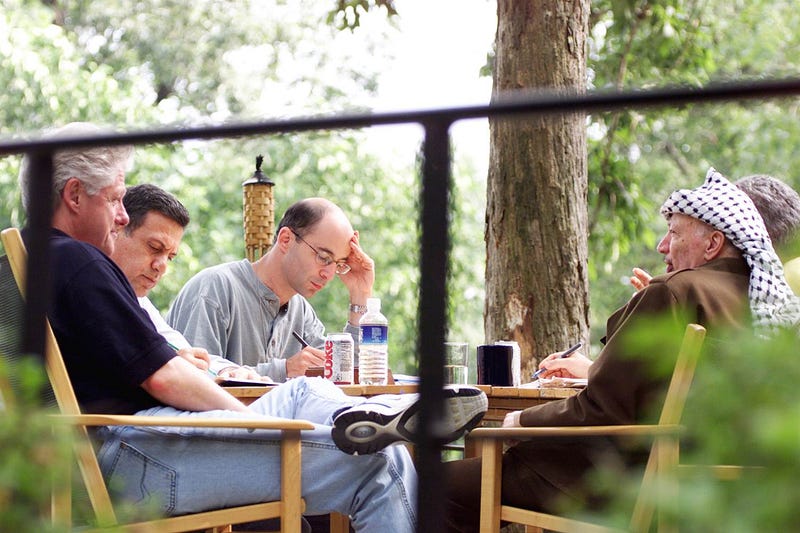
President Clinton and Yasser Arafat, then-Chairman of the Palestine Liberation Organization (PLO)

“If we’d had women at Camp David,” Bill Clinton later rued, “we’d have an agreement.”

There’s one thing that almost all negotiations between Israel and Palestine have had in common: a relative lack of women at the table.

It’s important not to neglect the important contributions several women have made to the much-maligned peace process. Dr. Hanan Ashrawi was a key player on the Palestinian team at the 1991 Madrid Conference as official spokesperson. Her prominence prompted the Israelis to summon their own female negotiator, Sarah Doron.

But by 1993, as talks towards the Oslo Accords progressed, it was clear that women would largely be limited to backseat roles.

One senior Palestinian negotiator at Oslo justified women’s exclusion by privately suggesting that the decisions taken were “too serious and monumental” for women to be involved as lead negotiators.

On the Israeli side, there was a clear divide: almost all the primary negotiators were men, while women were limited to the role of secretary, assistant or junior adviser.

Women’s lack of representation at the negotiating table has endured through the 20th and into the 21st century.
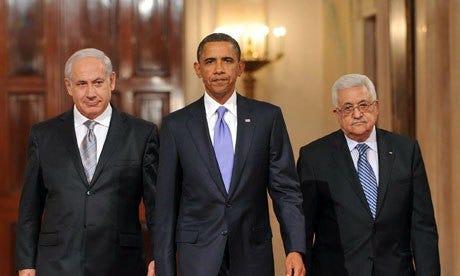
L to R: Israeli PM Benjamin Netanyahu, US President Barack Obama, Palestinian President Mahmoud Abbas
That raises two questions: (1) Why? And (2), does it matter?

Perhaps “cultural” or social norms play a role.

In both societies and economies, patriarchal structures exist that discriminate against women. Women are less likely to work. Those women who do work are less likely to occupy senior roles and less likely to receive fair pay. Women are less likely to enjoy their fundamental human rights.

These social or cultural norms have ramifications for many walks of life in both Israel and Palestine. But discrimination against women in the military and political spheres in particular has resulted in fewer women being picked to lead or join negotiating teams.

There’s mandatory military conscription for women in Israel, but they’re much less likely than men to serve in combat positions. The perception endures that men are the “real” soldiers.

But cultural norms aren’t the only factor at play here. Politics is also to blame. (Side note: When isn’t it?)

In trying to understand women’s marginalization from peace negotiations between Israel and Palestine, Espanioli and Sachs found that the perpetuation of the conflict itself has pushed “gender” off the table.

The conflict and the occupation are all-consuming. Perhaps unsurprisingly, it defines political competition and discourse in Palestine and Israel alike. And while both parties remain at diplomatic and military loggerheads, these scholars argue that “gender” issues continue to be pushed aside.

Any discourse that detracts from the main objective for each party is seen as an unhelpful distraction, somehow of secondary importance: How can we talk about gender now when we should be focusing all our efforts on securing our borders?; How can we talk about gender now when we should be focusing all our efforts on ending the occupation?

I’m clear about the answer to the second question. Does it matter? Yes. But maybe not only for the obvious reasons.
 
Let’s start with a basic principle, inherently normative in nature: public sector institutions should reflect the populations they serve. As well as representing the population’s interests, values and priorities, civil servants should accurately represent the demographic diversity of those societies — ethnic diversity, religious diversity, gender diversity and more.

The same should go for government delegations sent to peace negotiations.

Some might make the same argument but in utilitarian terms. Countless studies have shown that businesses that effectively leverage diversity — including gender diversity — do better in a multitude of ways. They’re more profitable, they’re more fulfilling places to work, and they’re more likely to retain talented staff.

It’s been claimed that women are inherently more peaceful than men. This utilitarian argument would therefore predict that having more women sat at the negotiating table would increase the likelihood of success at the next stage of the peace process between Palestine and Israel.

I resist essentialist arguments: That any one group of people exhibits any particular strength or deficiency based on any given biological trait they bear: like the gender they identify with, or the color of their skin. And since there’s evidence for and against the idea that women are more inherently peaceful than men, I’m not going to try to make any conclusions about that.

The more important conversation is about how to make gender front and center in future negotiations between Israel and Palestine.

That starts with having greater diversity in the two parties’ negotiating teams, but it certainly doesn’t end there.

The conflict and the occupation have profoundly different effects on men and women. And when peace processes fail to integrate women, peace agreements fail to address these differential gendered effects.

Those issues might include the impact of the occupation on girls’ access to education; how women’s sexual and reproductive health rights are threatened; how women’s economic opportunities are particularly constrained.

Leaders from Palestine, Israel and the international community can’t afford to regard these gendered consequences of conflict as an afterthought, to be dealt with once settlement construction, incitement to violence and movement and trade restrictions are resolved. They are part of the problem, and must be part of the solution.

So while having greater gender diversity at the table doesn’t necessarily mean those negotiators will be inherently or biologically more inclined to peace, it might prevent these issues being left off the agenda.

Hanan Ashrawi once remarked that “gender does not constitute a structured role in negotiations [between Israel and Palestine.]” It must if future rounds of peace talks are to succeed.

Tuesday, June 21, 2016

State of Women Summit and the Equal Pay Pledge

This week, the United State of Women Summit highlighted the importance of women’s issues in Washington, DC. BWWC Co-Chairs, Cathy Minehan and Evelyn Murphy, presented the work of the Boston Women’s Workforce Council and the Boston’s 100% Talent Compact. At the Summit, the White House introduced a similar initiative—the Equal Pay Pledge. This builds on the administration’s numerous actions to close the national pay gap (including passing the Lilly Ledbetter Fair Pay Act in 2009 and passing two executive orders on this issue in 2014–see my last blog post for more details).


Just as the BWWC is encouraging companies in Boston to sign the 100% Talent Compact, the White House is challenging businesses to take the Equal Pay Pledge.

The Equal Pay Pledge has companies commit to conducting an annual company-wide gender pay analysis across occupations; reviewing hiring and promotion processes and procedures to reduce unconscious bias and structural barriers; and embedding equal pay efforts into broader enterprise-wide equity initiatives.

Several private sector companies have come together to support advancing equal pay, including Airbnb, Amazon, Care.com, Deloitte, Johnson & Johnson, Pinterest, Spotify, Staples, Salesforce, and Slack, to name a few.

It’s exciting to see the White House take the initiative to close the gender pay gap on a nation-wide level through data collection and analysis, and exciting as well that Boston is on the forefront of these issues!


By Jessica, MPP '17
WAPPP Summer Intern Blog
Originally posted on Boston Women's Workforce Council Summer Experience

Reproductive Health in Humanitarian Crises

In my last post, I talked about one of the themes the Executive Director of UNFPA discussed in his statement to the UNFPA Executive Board. I’m going to discuss another one here that is incredibly relevant around the world: humanitarian crises. Whether because of natural disasters, pandemics, or conflict, women and girls are disproportionately vulnerable. More than 75% of the people affected by these crises are women and children, and the risks that women already face in their daily lives become heightened when resources are scarce and security breaks down.

Abuse, sexual exploitation, violence, and forced marriage all increase during crises, as well as illnesses and deaths related to reproductive health and pregnancy. Sexual and reproductive health services are difficult to access, if they exist at all, leaving women with few resources if they are victims of violence or are giving birth.

The experiences of women in Za’atari refugee camp in Jordan demonstrate how all these risks intersect. The camp is populated with Syrian refugees, who are already dealing with the psychological trauma of displacement. In such an insecure atmosphere, many families arrange marriages for their adolescent daughters, hoping it will keep them safe. However, child marriage exposes girls to many other dangers, especially pregnancy. In Za’atari, many of the pregnant women that health care workers attend are under 15. Many girls fear violence from their husband if they try to prevent or delay pregnancy. Once girls get married, it becomes difficult to continue their education and achieve their full potential.

UNFPA’s State of the World Population report from 2015 does a great job going into detail about the dynamics that threaten women and girls in humanitarian crises, and the steps that can be taken to address it.
  • Include family planning in basic emergency supplies delivered to those affected by the crisis, rather than treating it as an additional, optional service.
  • Couple family planning supplies with education targeted at women and men about how delaying first pregnancy and increasing the spacing between pregnancies is good for the health of the mother and the whole family.
  • Connect women, who may be dispersed in rural, hard-to-reach areas, to maternal and newborn health services.
  • Target assistance to HIV treatment and prevention.
  • Give adolescents access to education and vocational training. This will mitigate the vulnerability they face due to poverty and separation from their families, and give them the tools to be active advocates for positive change.
  • In all areas, work with local women to understand their unique challenges, as well as their input on solutions that make sense given their needs and context.
But most importantly, before a crisis hits, governments and civil society must work to address the underlying socioeconomic and structural issues that affect its severity and the possibility of full recovery. That includes investment in reproductive health infrastructure, education, and gender equality. The issue of reproductive health in humanitarian crises shows how gender, health, and economic development are intertwined. When women have the agency to contribute fully to their societies, then their societies will be that much more resilient and able to bounce back in the face of disasters.


By Morgan, MPP '17
WAPPP Summer Intern Blog
Originally posted on Wanted, Safe, Fulfilled: UNFPA Summer 2016